Dino Tales: Benji the Big Sneezy Dinosaur
Designing an Educational Storytelling Experience for preschoolers
A user-centered children’s book that helps young readers understand everyday experiences through storytelling and visual design
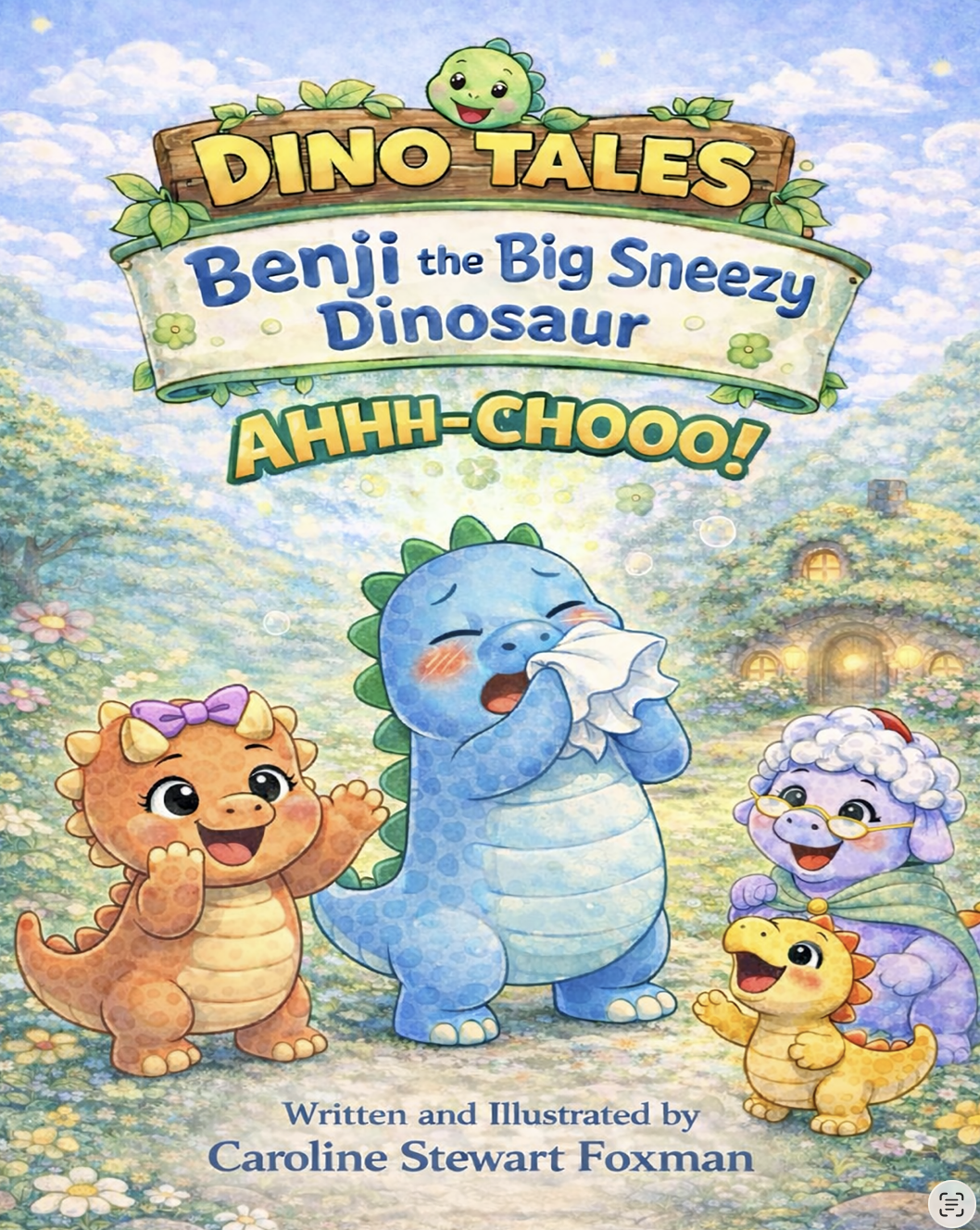
PROBLEM STATEMENT:
Preschool-aged children often experience big emotions and everyday challenges but lack accessible, engaging tools that help them understand and process these moments independently, Existing children’s book often fail to fully capture relatable experiences or maintain engagement, creating an opportunity to design a more effective storytelling solution.
USERS:
Primary Users:
Preschool children (ages 2-6)
Limited reading ability
Highly visual learners
Short attention span
Secondary Users:
Parents
Teachers
Caregivers
Timeline: Self-published February 2026
Overview: Designed and developed a children’s book from concept to launch, applying user-centered design principles to create an engaging and educational storytelling experience for preschool-aged children.
PAIN POINTS :
Through my experience as a preschool teacher, I observed recurring challenges in how young children engage with and understand educational content.
1.Difficulty Understanding Everyday Experiences
Young children struggle to process common experiences like being sick, emotions, and hygiene because explanations are often too abstract or complex for their developmental stage.
3.Lack of Relatable, Real-Life Scenarios
Stories do not always reflect situations children actually experience, making it harder for them to connect apply what they learn.
2.Low Engagement with Traditional Educational Content
Many children’s books rely on dense text or overly simple visuals, causing preschool-aged users to lose attention quickly.
4.Limited Tools for Parents and Educators
Caregivers often lack engaging, easy-to-use resources that help explain everyday topics in a way that is both educational and enjoyable.
GOAL:
Design an engaging, age-appropriate storytelling experience that helps preschoolers understand everyday experiences through relatable narratives and strong visual support
RESEARCH:
Observed children’s reactions to stories in classroom settings
Identified which types of visual held attention
Noted how repetition and simplicity improved comprehension
Analyzed popular children’s books for structure and engagement
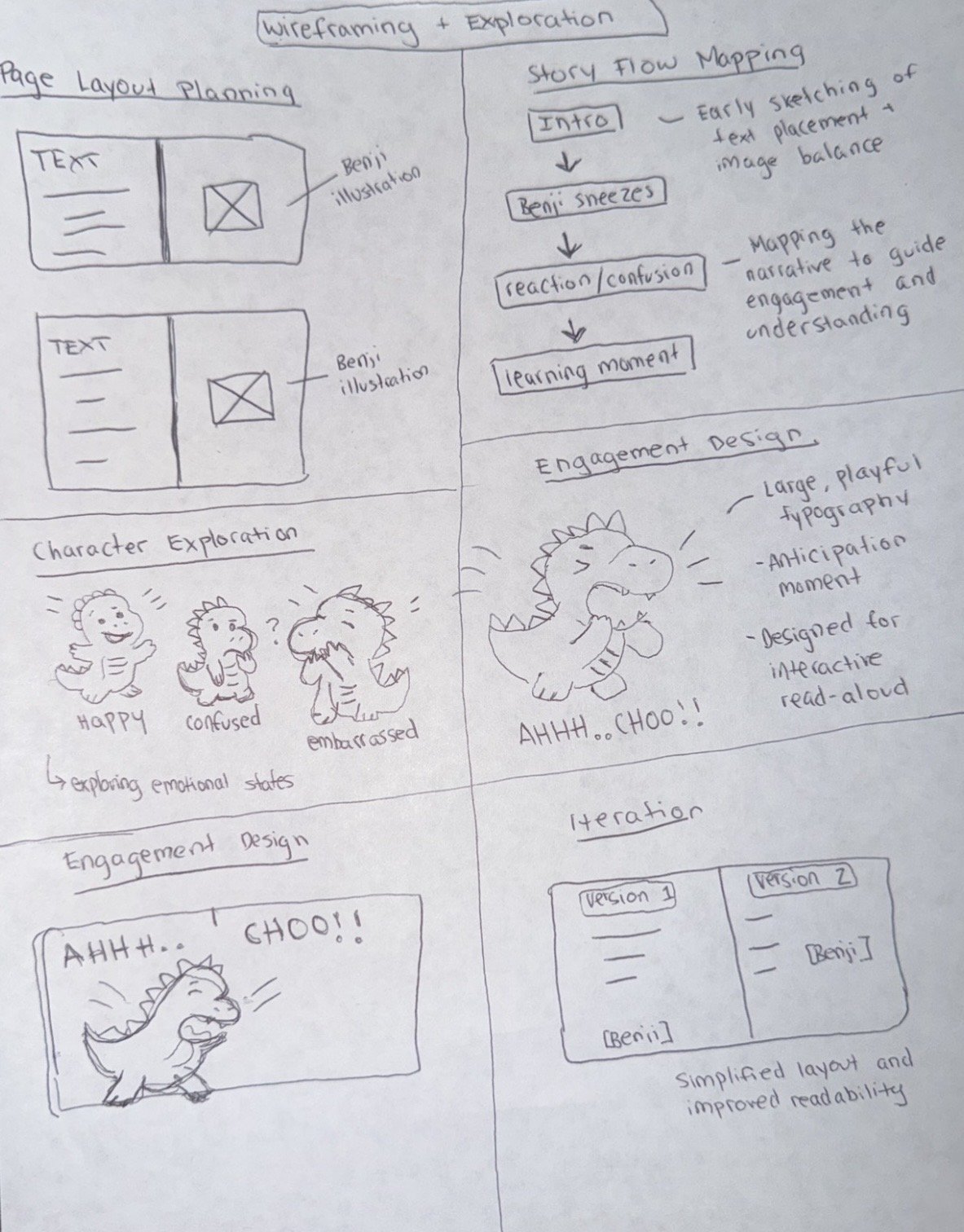
DESIGN PROCESS
WHAT I LEARNED:
Simplicity is critical in designing for young users
Visual storytelling can be more effective than text alone
Real-world observation is key to understanding user needs
Designing for children require balancing education and engagement
Role: Author, Illustrator, Designer
Tools: Figma, Canva, Adobe Creative Suite (Photoshop, Illustrator) Amazon KDP, Ingram Sparks, Chat GPT (ideation, content support)
IDEATION:
Brainstormed story concepts based on real classroom moments
Focused on “small but meaningful experiences” (like sneezing)
Developed character concepts (Benji) that feel friendly and relatable
WIREFRAMING:
Early sketches were used to explore layout, pacing, and engagement, ensuring the final design was clear, visually balanced, and developmentally appropriate for young users
Visual Design:
Character development
Color palette selection
Don’t readability for early learners
TESTING:
Read the book to children
Observed attention spans and reactions
Noted which paged they engaged with most
Adjusted pacing and visuals accordingly
FINAL SOLUTION:
A fully illustrated children’s book that:
Uses simple, engaging storytelling
Incorporates strong visual cues
Helps children understand everyday experiences
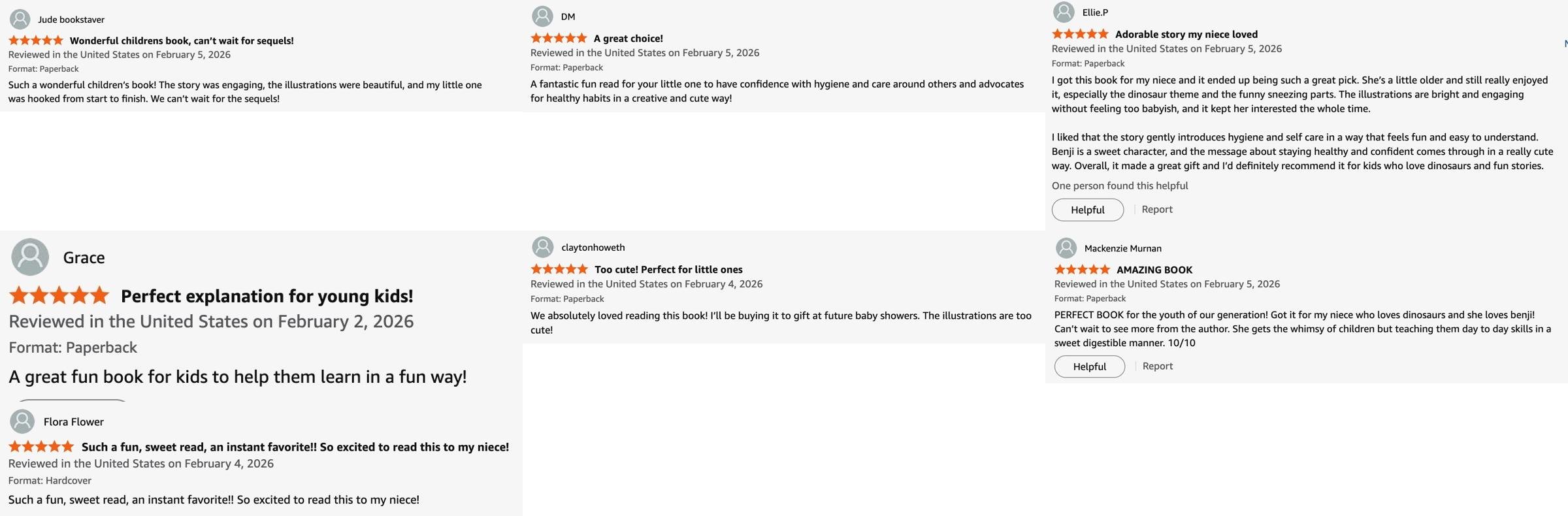
USER FEEDBACK & IMPACT :
Consistent positive feedback from parents, educators, and caregivers highlighted strong engagement, emotional connection, and educational value

KEY USER INSIGHTS
Strong Emotional Connection
“Made my children feel seen and understood”
“Opened up conversations about caring for ourselves and others”
Insight:
Children connected emotionally with the story, while parents valued its ability to support conversations around feelings and self-confidence
Educational Value Without Feeling “Preachy”
“Teaches hygiene in a fun and easy way”
“Not preachy… builds confidence and empathy”
Insight:
The book balances education and entertainment, making learning feel natural rather than instructional.
High Engagement & Re-readability
“My kids want me to read it every single night”
“Engaging from page one… we’ve read it multiple times already”
Insight:
The story structure and pacing successfully held attention and encouraged repeated interaction, a key goal for early childhood learning.
Visual Design Drives Engagement
“Bright and engaging illustrations”
“Cute characters… adorable problem and solution”
Insight:
Visual storytelling played a critical role in maintaining attention and enhancing comprehension for young users.
Parent and Educator Approval
“Kindergarten teacher here… a great addition to the classroom”
“Perfect for parents and classrooms”
Insight:
The product successfully serves both primary users (children) and secondary users (parents and educators)
Dino Tales: Benji the Big Sneezy Dinosaur is published and distributed through Amazon KDP and Ingram Sparks, with availability across major retail platforms including Barnes & Noble and Bookshop.org
Paperback (IngramSpark): 9798994680032
Hardcover (IngramSpark): 9798994680025
Amazon:
Barnes & Noble:
https://www.barnesandnoble.com/w/dino-tales-caroline-stewart-foxman/1149375948
Iteration:
Adjusted visual for clarity and engagement
Simplified layouts to avoid overstimulation
Layout Planning
Story Flow Mapping
Character Exploration
Engagement Design
Iteration
IMPACT:
Successfully published on Amazon and IngramSpark
Sold over 100 copies through Amazon KDP during first month
Available through major distribution channel
Positive feedback from parents/children’s
Demonstrated ability to bring concept → launch